

Why Choose a Liquid Filled Pressure Gauge Over a Dry Gauge?
2026-02-25
In industrial environments, the humble pressure gauge is often the unsung hero of daily operations. However, when equipment is subjected to constant vibration, pressure spikes, or corrosive atmospheres, a standard dry gauge often falls short. This is where the Liquid Filled Pressure Gauge becomes not just an option, but a necessity. By filling the case with a damping fluid—typically glycerin or silicone oil—these instruments offer superior performance and longevity compared to their dry counterparts .
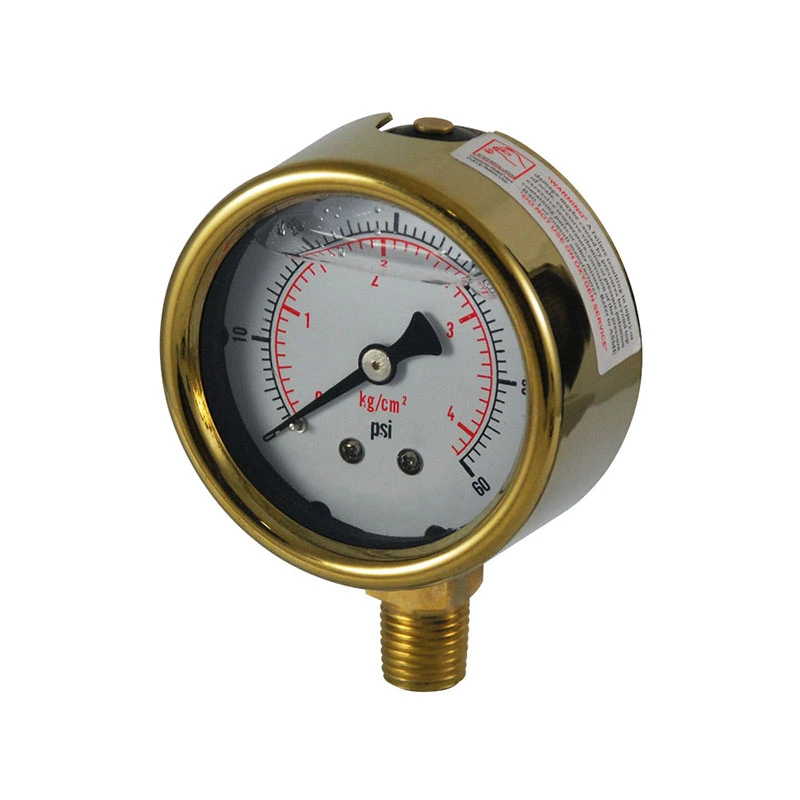
How It Works: The Principle of Dampening
The primary function of the liquid fill is to submerge the internal working parts (the Bourdon tube, movement, and link) in a viscous fluid. This fluid creates resistance against rapid movements. When a machine pulsates or vibrates, the liquid absorbs the kinetic energy, preventing it from transferring directly to the delicate pointer and gear system. The result is a steady, readable needle rather than a fluttering one that is impossible to read accurately .
The Importance of Liquid Fill in Harsh Conditions
Why is this important? In applications like hydraulic power units, reciprocating compressors, or off-road vehicles, vibration is a leading cause of gauge failure. Dry gauges in these environments suffer from accelerated wear due to friction, leading to inaccurate readings and premature replacement . Additionally, liquid filling acts as a barrier. It prevents moisture-laden air from entering the case, which eliminates condensation (fogging) and internal corrosion—common issues that render a gauge unreadable .
Key Benefits at a Glance
To summarize the operational advantages, here is a comparison of how a Liquid Filled Pressure Gauge performs against a standard Dry Gauge:
| Feature | Liquid Filled Pressure Gauge | Dry Pressure Gauge |
|---|---|---|
| Vibration/Pulsation | Dampened effect; steady pointer | Needle flutter; difficult to read |
| Internal Wear | Lubricated moving parts; extended life | Friction on pivots/gears; shorter lifespan |
| Environmental Resistance | Sealed case prevents corrosion/icing | Prone to condensation and moisture ingress |
| Reading Stability | Smooth reaction to pressure spikes | Jumps erratically; risk of damage from spikes |
Selecting the Right Fill Fluid
To achieve these effects, the choice of fill fluid must match the operating environment. While glycerin is the most common choice for general-purpose dampening due to its excellent lubricity, it is not suitable for every condition .
-
Glycerin (99.5% Pure): Best for moderate temperatures, typically between 35°F and 150°F. It provides the best dampening performance for standard industrial applications .
-
Silicone Oil: Used in extreme cold or heat. It remains stable in temperatures as low as -100°F and is also preferred when the gauge includes electrical contacts, as it is non-conductive .
-
Mineral Oil or Halocarbon: Mineral oil is used for specific media compatibility, while Halocarbon is essential for oxygen service due to its chemical inertness .
Installation Best Practices
Even the best Liquid Filled Pressure Gauge requires correct installation to ensure accuracy. One critical step often overlooked is venting. Most liquid-filled gauges come with a fill plug. After installation, the tip of this plug should be cut or loosened to allow air pressure inside the case to equalize with the atmosphere. If the case is not vented, temperature changes can cause the liquid to expand or contract, creating internal pressure that leads to zero shift and inaccurate readings .
Durability You Can Rely On
Ultimately, investing in a liquid-filled gauge is a decision for reliability. Whether monitoring pressure on a fire apparatus, managing hydronic systems, or ensuring safety in chemical processing, the dampening effect protects the gauge mechanism from the "three killers": vibration, pulsation, and corrosion . By stabilizing the pointer and lubricating the movement, it ensures that operators receive precise data when they need it most, reducing downtime and maintenance costs.
At Ningbo Rising Instrument Co., Ltd. , we understand the demands of precise pressure measurement. Our range of liquid-filled pressure gauges is engineered to provide the durability and clarity required for the most challenging applications.
For expert advice on selecting the right gauge for your specific pressure, temperature, and media requirements, please contact us today to discuss your application and ensure your operations run smoothly and safely.