

Which Black Steel Case Thermo-manometer Is Right for Your Application?
2026-11-23
A Black Steel Case Thermo-manometer is a combined pressure and temperature measuring instrument designed to display two important operating parameters in one unit. Its black steel housing provides a protective external structure, while its internal pressure and temperature sensing systems perform their respective measurement functions. Selecting the correct model requires attention to pressure range, temperature range, connection type, dial size, probe dimensions, measuring medium, and installation environment. Understanding these factors helps industrial buyers choose a suitable instrument and avoid unnecessary replacement or measurement problems.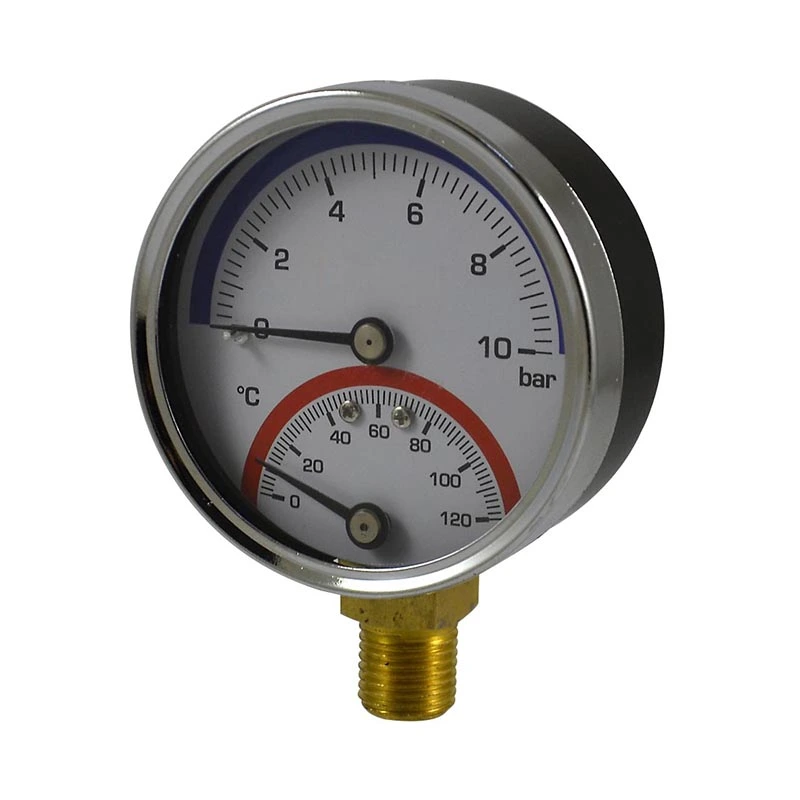
1. What Is a Black Steel Case Thermo-manometer?
A Black Steel Case Thermo-manometer is a mechanical measuring instrument that combines pressure indication and temperature indication within a single housing. It is commonly used in systems where both parameters need to be monitored at the same operating location.
In conventional installations, pressure gauges and thermometers are often installed separately. Although this arrangement provides independent measurements, it may require additional mounting points, connections, installation space, and maintenance work. A combined thermo-manometer helps address these challenges by integrating both readings into one instrument.
The black steel case serves as the external housing for the measuring mechanism. It provides structural support and helps protect internal components from ordinary contact and environmental exposure. Depending on the specific construction, the instrument may also include a protective window, dial plate, pointer mechanism, pressure connection, and temperature sensing probe.
It is important to understand that the exact construction of a thermo-manometer can vary between models. Pressure and temperature readings are produced by separate sensing mechanisms, even when they share one dial assembly or instrument housing.
For equipment manufacturers, heating system suppliers, and industrial distributors, this combination offers a convenient way to monitor operating conditions while keeping the equipment layout relatively compact.
2. How Does a Thermo-manometer Work?
The operating principle of a thermo-manometer involves two independent measurement processes: pressure sensing and temperature sensing. Each system responds to a different physical change and transfers the resulting movement to its corresponding pointer or indication scale.
2.1 Pressure Measurement Principle
Many mechanical pressure gauges use a Bourdon tube as their sensing element. This curved metal tube has an oval or elliptical cross-section. When pressurized fluid enters the tube, the cross-section tends to become more circular, causing the curved tube to change its shape slightly.
The free end of the Bourdon tube moves as pressure changes. A mechanical linkage transfers this displacement to a movement mechanism, which rotates the pointer across the pressure scale.
This arrangement allows operators to observe pressure changes directly without requiring an external power supply. The actual pressure range and accuracy depend on the instrument's design, sensing element, and manufacturing specifications.
2.2 Temperature Measurement Principle
The temperature measuring system may use a bimetallic, liquid-expansion, or another suitable mechanical sensing arrangement, depending on the product design.
In a common bimetallic design, two bonded metal strips with different thermal expansion characteristics form a sensing element. When temperature changes, the two metals expand at different rates. This causes the element to bend or rotate, and the movement is transferred to a pointer.
In a liquid-expansion design, a sealed measuring system responds to temperature changes through changes in the internal pressure of its filling liquid. The resulting movement operates a mechanical indicator.
Therefore, buyers should confirm the actual temperature sensing principle and construction with the manufacturer instead of assuming that every thermo-manometer uses the same internal mechanism.
2.3 Two Measurements in One Instrument
The main purpose of combining these functions is to make operating information easier to access. An operator can check the pressure and temperature conditions at the same location without reading two separate instruments.
However, the two measurement systems still require their own appropriate sensing arrangements. Correct probe placement, pressure connection selection, and installation conditions remain essential for reliable readings.
3. What Are Its Main Components?
Understanding the major components of a Black Steel Case Thermo-manometer helps purchasing teams evaluate product quality and determine whether a particular model suits their equipment.
The external housing supports and encloses the internal measuring components. Its material and surface treatment influence durability and suitability for different environments.
The dial displays pressure and temperature values through clearly marked scales. Suitable graduation and readability are important for daily operation.
The mechanical movement transfers sensor displacement into pointer rotation, allowing operators to read changing operating conditions.
The pressure-sensitive component, commonly a Bourdon tube in mechanical designs, responds to the pressure inside the connected system.
The temperature sensing component detects thermal changes through its designated probe or measuring element.
The connection provides the interface between the instrument and the equipment. Thread type, size, and orientation must match the installation requirements.
Other construction details may include a transparent window, sealing components, a protective bezel, and additional mounting accessories. Buyers should review the product drawing or technical datasheet to confirm the actual configuration.
4. Key Advantages of a Black Steel Case Design
The housing material is an important part of instrument selection. A black steel case is widely used in mechanical instruments because it provides a practical balance of structural support, appearance, and manufacturing flexibility.
4.1 Practical Mechanical Protection
A steel enclosure offers a rigid structure around the measuring mechanism. It helps protect the instrument from ordinary external contact during installation and operation. Nevertheless, the actual resistance to impact, moisture, dust, and corrosion depends on the complete instrument design and its specified protection level.
4.2 Compact Equipment Integration
Combining pressure and temperature indication can reduce the number of separate instruments required at a monitoring point. This is particularly useful in compact heating equipment, water circulation systems, and machinery with limited panel or pipeline space.
4.3 Convenient Visual Monitoring
Two operating parameters can be checked from one instrument position. This makes routine inspections more convenient and helps operators identify unusual changes that may require further investigation.
4.4 Cost-Conscious Instrument Configuration
For suitable applications, using one combined instrument may simplify mounting arrangements and reduce the number of separate instrument connections. The total cost advantage should be evaluated according to the required model, installation accessories, and maintenance needs.
4.5 Professional Industrial Appearance
The black case offers a clean, conventional appearance that can integrate well with many industrial machines, heating units, and mechanical equipment designs.
5. Where Are Thermo-manometers Commonly Used?
Thermo-manometers are particularly useful in equipment where pressure and temperature are closely related to normal operating conditions. Their applications cover several industrial and commercial sectors.
5.1 Heating and Hot Water Systems
Heating systems require regular monitoring of water pressure and temperature. A combined instrument allows maintenance personnel to observe these two parameters at a convenient location. It can be used in suitable boilers, heating units, and hot water circulation equipment.
5.2 Boiler and Thermal Equipment
Pressure and temperature are important operating variables in boiler-related equipment. A suitable thermo-manometer can provide local indication for routine monitoring, provided its pressure and temperature ranges meet the equipment requirements.
5.3 Water Circulation and Pump Systems
In certain water circulation installations, operators need to check pressure conditions alongside water temperature. A combined measuring instrument can help simplify the monitoring arrangement.
5.4 HVAC Equipment
Heating, ventilation, and air conditioning systems contain different fluid circulation and heat exchange processes. Depending on the system design, thermo-manometers can provide useful local readings at designated monitoring points.
5.5 Industrial Machinery
Some industrial machines and processing equipment require convenient pressure and temperature indication during operation. The instrument can be integrated into suitable machinery where the measured medium, operating range, and connection arrangement are compatible.
| Application | Monitoring Requirement | Selection Priority |
|---|---|---|
| Heating systems | Water pressure and temperature | Measurement ranges and connection compatibility |
| Boiler equipment | Operating pressure and thermal conditions | Rated limits and safety requirements |
| Water circulation | Pressure and water temperature | Probe arrangement and installation position |
| HVAC equipment | System pressure and thermal monitoring | Dial readability and operating environment |
| Industrial machinery | Local operating condition monitoring | Medium compatibility and mechanical durability |
The applications above are general examples. Final suitability must be determined by checking the instrument's rated specifications against the actual system conditions.
6. How to Choose the Right Black Steel Case Thermo-manometer
Choosing a suitable instrument involves more than checking its appearance or purchasing price. A mismatch between the instrument and the application may cause poor readability, inaccurate indication, installation difficulties, or premature failure.
6.1 Confirm the Required Pressure Range
Determine the normal operating pressure, expected pressure fluctuations, and maximum permitted system pressure before selecting a pressure scale.
A suitable measurement range should allow the normal operating pressure to be read clearly without continuously operating near the upper limit. For applications involving frequent pressure fluctuations, consult the manufacturer's recommendations regarding operating limits and pulsation protection.
6.2 Select the Appropriate Temperature Range
Identify the normal temperature, minimum and maximum operating temperatures, and any temporary temperature variations. The instrument's temperature measuring range must cover the actual process conditions.
Do not select a temperature range based only on the system's average temperature. Consider possible startup, shutdown, and abnormal operating conditions as well.
6.3 Check Dial Diameter and Readability
Dial size influences how easily operators can read the instrument from the normal viewing distance. A larger dial may be preferable for equipment installed in locations where the operator cannot stand close to the instrument.
Also check scale layout, unit markings, pointer visibility, and whether the pressure and temperature indications can be distinguished clearly.
6.4 Verify the Process Connection
Connection compatibility is essential for correct installation. Check the thread standard, nominal size, mounting direction, and connection position before ordering.
Common connection standards in the instrument market include BSP and NPT, but the exact available options depend on the manufacturer and product model.
6.5 Evaluate the Temperature Probe
Probe length, diameter, insertion depth, and mounting arrangement affect temperature measurement. The probe must be positioned appropriately within the process medium to achieve representative readings.
Buyers should also confirm whether a thermowell or protective sleeve is required by the application.
6.6 Consider the Working Medium
Water, steam, oil, air, and other process media have different operating characteristics. The wetted materials and pressure sensing element must be compatible with the medium.
For corrosive fluids, aggressive chemicals, or unusual process conditions, a standard configuration may not be suitable. Ask the manufacturer to evaluate material compatibility before confirming the order.
6.7 Check Environmental Conditions
Consider humidity, dust, vibration, ambient temperature, and potential exposure to water or chemicals. A black steel case may be suitable for many ordinary environments, but additional protection or a different housing material may be necessary under demanding conditions.
6.8 Review Accuracy and Applicable Requirements
Check the required accuracy of both measurement functions. Pressure accuracy and temperature accuracy should be evaluated separately because they may follow different specifications and measurement standards.
| Selection Item | Questions to Confirm | Why It Matters |
|---|---|---|
| Pressure range | What are the normal and maximum pressures? | Prevents range mismatch |
| Temperature range | What are the minimum and maximum temperatures? | Ensures suitable thermal measurement |
| Dial size | What is the required viewing distance? | Improves reading convenience |
| Connection | Which thread type, size, and orientation are needed? | Avoids installation problems |
| Probe dimensions | What insertion length and diameter are required? | Supports proper temperature sensing |
| Medium compatibility | What fluid or gas will be measured? | Reduces material compatibility risks |
| Environment | Will the instrument face moisture, vibration, or dust? | Helps determine housing protection needs |
7. Installation Factors That Affect Measurement Performance
Even a well-manufactured thermo-manometer may provide unreliable readings if it is installed incorrectly. Proper installation helps protect the measuring mechanism and supports stable operation.
7.1 Choose an Appropriate Installation Location
Install the instrument where operators can read the dial conveniently and where the location represents the actual system conditions. Avoid unnecessary exposure to direct mechanical impacts, excessive heat, and severe environmental conditions.
7.2 Ensure Correct Connection Matching
Verify the connection thread and mounting arrangement before installation. Use appropriate sealing components and installation methods recommended for the specific connection type. Avoid applying excessive tightening force, which may damage threads or instrument connections.
7.3 Position the Temperature Probe Correctly
The temperature sensor should have sufficient contact with the process medium to obtain a representative measurement. Incorrect insertion depth, poor thermal contact, or installation in a stagnant area may result in misleading readings.
7.4 Minimize Vibration and Mechanical Stress
Continuous vibration and pressure pulsation can affect mechanical measuring instruments. Where necessary, use suitable protective accessories or installation arrangements recommended by the manufacturer.
7.5 Check the System Before Operation
After installation, inspect the connection for leakage, confirm that the instrument is securely mounted, and verify that the pointers respond appropriately under controlled operating conditions.
For high-pressure or high-temperature applications, installation and commissioning should be carried out by qualified personnel in accordance with the equipment manufacturer's instructions and applicable safety procedures.
8. Maintenance and Troubleshooting
Routine inspection is important for maintaining the readability and reliability of a mechanical thermo-manometer. Although the instrument does not normally require an external power supply, its mechanical components can still be affected by operating conditions over time.
8.1 Recommended Inspection Activities
- Inspect the case and window for visible damage, corrosion, or cracks.
- Check whether the dial markings and pointer remain clearly visible.
- Inspect the process connection for leakage or looseness.
- Look for unusual pointer movement or indications that remain fixed.
- Check the temperature probe for damage or incorrect positioning.
- Arrange periodic calibration or verification according to application requirements.
8.2 Common Problems and Possible Causes
| Problem | Possible Cause | Recommended Action |
|---|---|---|
| Pressure reading is unstable | Pressure pulsation, vibration, or connection issues | Inspect the system and evaluate suitable damping measures |
| Temperature reading is incorrect | Incorrect probe position or sensor damage | Check insertion depth and sensor condition |
| Pointer does not move | Blocked connection or damaged internal mechanism | Remove the instrument from service and arrange inspection |
| Visible leakage | Damaged sealing or incompatible connection | Shut down safely and inspect the connection |
| Dial is difficult to read | Window damage, contamination, or poor visibility | Inspect the window and consider replacement if necessary |
Never attempt to repair a pressurized instrument while it remains connected to an operating system. Isolate the equipment, release pressure safely, and follow the manufacturer's maintenance instructions before inspection or replacement.
9. Common Purchasing Mistakes to Avoid
For distributors, OEM manufacturers, engineering contractors, and industrial buyers, several purchasing mistakes can lead to unnecessary costs and installation delays.
Mistake 1: Selecting Only by Appearance
A black steel case may match the equipment design, but appearance alone does not establish measurement suitability. Always verify the pressure and temperature specifications.
Mistake 2: Ignoring Connection Details
Two instruments with similar appearances may have different connection threads, positions, or dimensions. Confirm these details against the equipment drawing before ordering.
Mistake 3: Overlooking Probe Requirements
The temperature probe must fit the installation point and provide suitable contact with the measured medium. An unsuitable probe length may lead to installation difficulties or poor readings.
Mistake 4: Assuming All Measuring Ranges Are Standard
Different applications require different combinations of pressure and temperature ranges. Buyers should not assume that one configuration can satisfy every system requirement.
Mistake 5: Failing to Confirm Product Documentation
Request technical drawings, datasheets, material details, and relevant inspection or calibration documentation when required. Clear documentation helps purchasing departments compare products and verify specifications before shipment.
Mistake 6: Ignoring Long-Term Supply Requirements
For OEM projects and wholesale purchasing, consistency between batches is important. Discuss product specifications, quality inspection arrangements, packaging, and repeat-order requirements with the supplier in advance.
10. Frequently Asked Questions
Q1: What is a Black Steel Case Thermo-manometer used for?
It is used to measure and display pressure and temperature in one instrument. Typical applications include suitable heating systems, boiler equipment, water circulation installations, HVAC systems, and industrial machinery.
Q2: What is the difference between a pressure gauge and a thermo-manometer?
A conventional pressure gauge measures pressure only, while a thermo-manometer combines pressure and temperature measurement. The combined design is useful when both operating parameters need to be monitored at one location.
Q3: Does a thermo-manometer require electricity?
Many conventional mechanical thermo-manometers operate through mechanical sensing systems and do not require an external electrical power supply. However, special electronic or signal-output versions may have different requirements.
Q4: Why does a thermo-manometer have two measurement scales?
The instrument is designed to display two different physical parameters. One scale indicates pressure, while the other indicates temperature. The scale units and ranges depend on the selected model.
Q5: Can a Black Steel Case Thermo-manometer be used in outdoor environments?
Outdoor suitability depends on the housing finish, sealing arrangement, ingress protection, ambient temperature, and exposure conditions. Confirm the specified environmental protection level with the manufacturer before outdoor installation.
Q6: How do I choose the correct pressure range?
Start with the normal operating pressure and maximum expected system pressure. Select a suitable scale that provides clear readings during normal operation while respecting the manufacturer's recommended operating limits.
Q7: Can the instrument be customized for OEM projects?
Customization availability depends on the manufacturer's production capabilities. Potential requirements to discuss include dial diameter, pressure range, temperature range, connection type, probe dimensions, dial markings, and branding.
Q8: How often should a thermo-manometer be calibrated?
Calibration frequency depends on the application, operating environment, accuracy requirements, and quality management procedures. Critical installations may require more frequent verification than general monitoring applications. Follow the manufacturer's recommendations and applicable industry requirements.
Q9: What information should I provide when requesting a quotation?
Provide the required pressure and temperature ranges, dial size, connection thread, probe dimensions, measuring medium, operating environment, quantity, and any special OEM requirements. Drawings or photographs of the installation point can also help clarify technical requirements.
Q10: How can I determine whether a thermo-manometer is suitable for my equipment?
Compare the instrument's complete technical specifications with the actual operating conditions. Pay particular attention to pressure limits, temperature range, wetted materials, connection compatibility, probe installation, and environmental protection. Consult the manufacturer if any operating condition is uncertain.
11. Why Work with Ningbo Rising Instrument Co.,Ltd.?
Choosing an appropriate measuring instrument is an important part of building reliable equipment and maintaining consistent operating performance. Buyers need more than a product that looks suitable. They need clear technical specifications, dependable communication, and a supplier who understands the importance of matching the instrument to its intended application.
Ningbo Rising Instrument Co.,Ltd. focuses on providing instrument solutions for customers who require practical measurement products for industrial and commercial applications.
When evaluating a Black Steel Case Thermo-manometer for your project, discussing the application requirements with the supplier can help you identify the right product configuration before ordering.
Whether you are an equipment manufacturer, industrial distributor, engineering contractor, or wholesale buyer, providing detailed specifications at the inquiry stage helps improve product matching and purchasing efficiency.
- Discuss the required pressure and temperature measuring ranges.
- Confirm case dimensions, dial size, and connection specifications.
- Check temperature probe requirements and installation conditions.
- Communicate OEM requirements and special product configurations.
- Confirm technical documentation and order details before production.
Looking for a Reliable Black Steel Case Thermo-manometer Supplier?
The right measuring instrument starts with the right specifications. Contact Ningbo Rising Instrument Co.,Ltd. to discuss your application, product requirements, and purchasing plans. Our team can help you evaluate suitable thermo-manometer configurations for your project.
Contact us today to discuss your requirements and request product information or a quotation.
Contact Us for an InquiryDisclaimer: Product construction, available configurations, measurement ranges, and technical performance may vary by model. Always refer to the manufacturer's official datasheet and installation instructions for confirmed specifications.