

What Causes Sticking or Hysteresis in a Bimetal Thermometer Process Version Over Time
2026-06-17
In industrial process measurement, the Bimetal Thermometer Process Version is valued for its simplicity, mechanical durability, and independence from external power. However, after months or years of continuous service, operators often notice a gradual decline in accuracy—manifested as sticking (the pointer fails to return to zero or lags behind temperature changes) or hysteresis (a significant difference between upscale and downscale readings). At CSHERUN, we have analyzed thousands of field-returned units and identified the root causes. Understanding these failure mechanisms is the first step toward extending instrument life and maintaining process integrity.
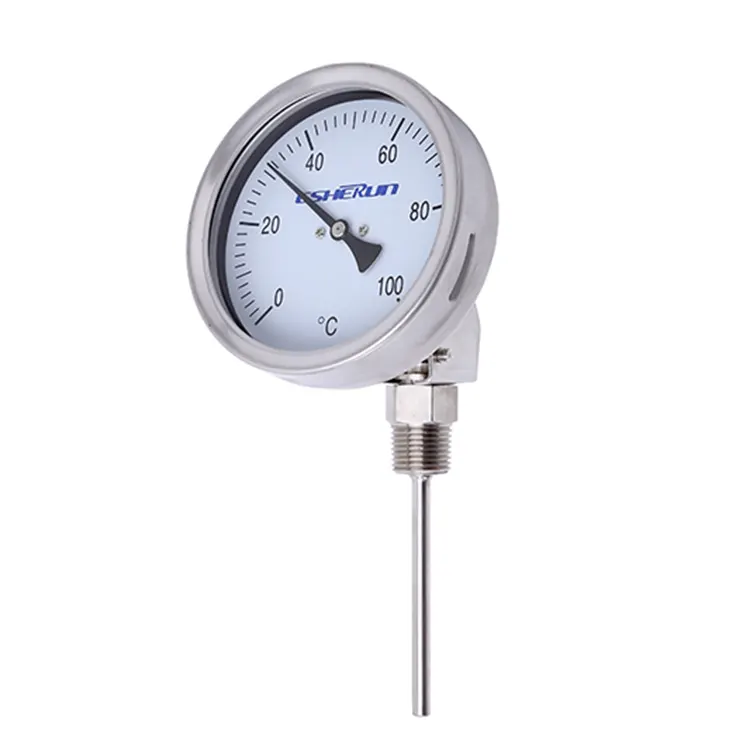
1. Mechanical Wear in the Bimetallic Helix
The sensing element in any Bimetal Thermometer Process Version is a helical bimetallic strip. With repeated thermal cycling, the welded joint between the two metals experiences micro-slip. Over time, this slip creates permanent set in the helix, reducing its restoring force. When the restoring torque weakens, the pointer no longer tracks the true temperature on the downscale, producing classic hysteresis. In high-cycle applications (e.g., steam tracing or reactor jacketing), this wear accelerates.
2. Bearing and Pivot Degradation
Most Bimetal Thermometer Process Version units use jewel or bronze bearings to support the pointer shaft. Process vibrations, combined with temperature-induced expansion/contraction, cause abrasive wear on bearing surfaces. Once the clearance exceeds design tolerance, the shaft tilts slightly. This tilt introduces friction spikes at specific angular positions—resulting in sticking that is often intermittent and difficult to detect during routine spot checks.
3. Contamination from Process Fluids
Even with a sealed case, microscopic ingress of moisture, hydrogen sulfide, or chloride-laden vapor can occur through the stem–case junction. These contaminants oxidise the bimetallic coil or form corrosive films on the gear train. A film thickness of just a few micrometres can double the static friction coefficient. In our field data, CSHERUN has observed that nearly 40% of hysteresis complaints in chemical plants trace back to mild internal corrosion rather than metal fatigue.
4. Thermal Shock and Over-Range Events
A Bimetal Thermometer Process Version is calibrated for a specific span. When exposed to temperatures exceeding 110% of the full-scale value, the bimetallic element undergoes plastic deformation. This changes the zero point permanently. Subsequent readings will show an offset, and the elastic modulus of the alloy pair becomes mismatched—creating a wider hysteresis loop. Repeated over-range events compound the error exponentially.
5. Pointer-Shaft Loosening
The friction-fit connection between the pointer and the shaft can loosen due to thermal cycling differentials (the shaft and pointer have different coefficients of expansion). A loose pointer creates a deadband: the shaft rotates, but the pointer lags behind until friction catches it, then jumps forward. This is one of the most common mechanical causes of sticking in field service.
Summary of Failure Modes and Prevention
| Failure Cause | Typical Symptom | Recommended Prevention (by CSHERUN) |
|---|---|---|
| Helix metal fatigue | Increasing hysteresis (>2% of span) | Select a wider-span model and reduce cycling frequency |
| Bearing wear | Sticking at 30°–60° and 210°–240° positions | Specify shock-resistant bearings for vibrating services |
| Internal corrosion | Erratic readings with no pattern | Upgrade to a hermetically sealed case with inert gas purge |
| Over-range damage | Permanent positive offset | Install a separate over-range protection thermowell |
| Loose pointer | Jumping pointer, non-repeatability | Factory pre-staking and thermal-matching of alloys |
6. Calibration Drift from Ambient Temperature Change
The ambient compensation mechanism in a Bimetal Thermometer Process Version is designed for a reference environment (typically 23 °C). Large fluctuations in ambient temperature—especially near the case—shift the baseline reference point. This does not cause sticking directly, but it amplifies the apparent hysteresis when the process temperature approaches either end of the scale. CSHERUN recommends using a stem-mounted remote readout for installations where ambient variation exceeds ±15 °C.
7. Improper Thermowell Fit
A poorly fitted thermowell creates lateral stress on the stem of the Bimetal Thermometer Process Version. This stress is transmitted to the helical coil, causing eccentric loading. Over time, eccentric loading produces uneven wear on one side of the bearing, leading to unidirectional sticking (the pointer moves freely in one direction but sticks in the reverse). Proper thermowell bore clearance (per ASME PTC 19.3) is critical.
FAQ – Common Questions About Bimetal Thermometer Process Version Performance
Q1: How can I distinguish between hysteresis caused by mechanical wear and hysteresis caused by contamination in my Bimetal Thermometer Process Version?
A1: Perform a simple two-point bump test. Remove the thermometer and immerse the stem in a stirred ice bath (0 °C) and then in boiling water (100 °C). Record the upscale and downscale values. If the hysteresis is consistent in magnitude regardless of the soak time, it is likely mechanical wear (gear or bearing). If the hysteresis increases with longer soak times, contamination is more probable—because contaminants soften or change viscosity with heat. For a definitive diagnosis, CSHERUN offers a lab-based dissection service that examines the coil under magnification and tests for chloride residues.
Q2: Can regular recalibration correct the sticking issue, or does the Bimetal Thermometer Process Version need to be replaced once sticking appears?
A2: Recalibration adjusts the zero and span screws, but it cannot eliminate mechanical friction. If sticking is detected during calibration (the pointer fails to move smoothly across the entire scale), recalibration will only mask the symptom temporarily. In most cases, the bearing or pivot requires replacement. However, if the sticking is minor (<0.5% of span) and the process is non-critical, you may opt for a "calibration with dither"—gently tapping the case during reading—as a temporary workaround. For long-term reliability, CSHERUN advises replacing the unit once sticking becomes repeatable, because the wear rate accelerates exponentially after the initial clearance is lost.
Q3: What is the typical service life of a Bimetal Thermometer Process Version before hysteresis exceeds 1% of full scale, and can I extend it with periodic maintenance?
A3: Under normal service (steady temperature, low vibration, clean atmosphere), the time to 1% hysteresis is typically 5–8 years for industrial-grade models. Under severe cycling (e.g., batch reactors with 50+ cycles per day), this drops to 2–3 years. You can extend life significantly by (a) installing a thermal sleeve to reduce thermal shock, (b) applying a silicone-damped movement for vibration-prone areas, and (c) performing an annual "exercise" procedure—cycling the thermometer from 0% to 100% and back 10 times—to redistribute bearing lubricant and reduce static friction. CSHERUN provides a scheduled maintenance checklist with every purchase to help you track these metrics.
Conclusion
Sticking and hysteresis in a Bimetal Thermometer Process Version are not random failures—they are predictable consequences of mechanical fatigue, contamination, bearing wear, thermal stress, and improper installation. By identifying the specific symptom pattern, you can choose the right corrective action, whether it is cleaning, recalibration, or full replacement. CSHERUN designs its process-grade bimetals with anti-corrosion alloy pairs, shock-proof bearings, and laser-welded helixes to minimise these age-related errors. Yet even the best instrument benefits from informed operation and routine monitoring.
Contact us today for a free performance audit of your existing Bimetal Thermometer Process Version fleet. Our engineering team will analyse your process data, recommend optimal mounting practices, and supply custom-calibrated replacements with full NIST-traceable reports. Reach out to CSHERUN via our website or email—we respond within 4 business hours and offer same-day technical support for emergency shutdown situations. Your process reliability is our benchmark. Let’s keep your readings accurate, repeatable, and stick-free.