

What Are the Common Failure Modes of a Pressure Type Temperature Gauge
2026-06-24
In critical industrial environments—from oil refineries to pharmaceutical labs—reliable temperature measurement is non‑negotiable. The Pressure Type Temperature Gauge (also known as a filled‑system thermometer) is prized for its simplicity, robustness, and ability to transmit readings over distances without external power. However, like any mechanical instrument, it is susceptible to specific failure modes. Understanding these failure patterns is essential for maintenance teams, reliability engineers, and procurement specialists. At CSHERUN, we have spent over a decade dissecting field returns and on‑site failures to help our clients extend gauge life and avoid unplanned shutdowns.
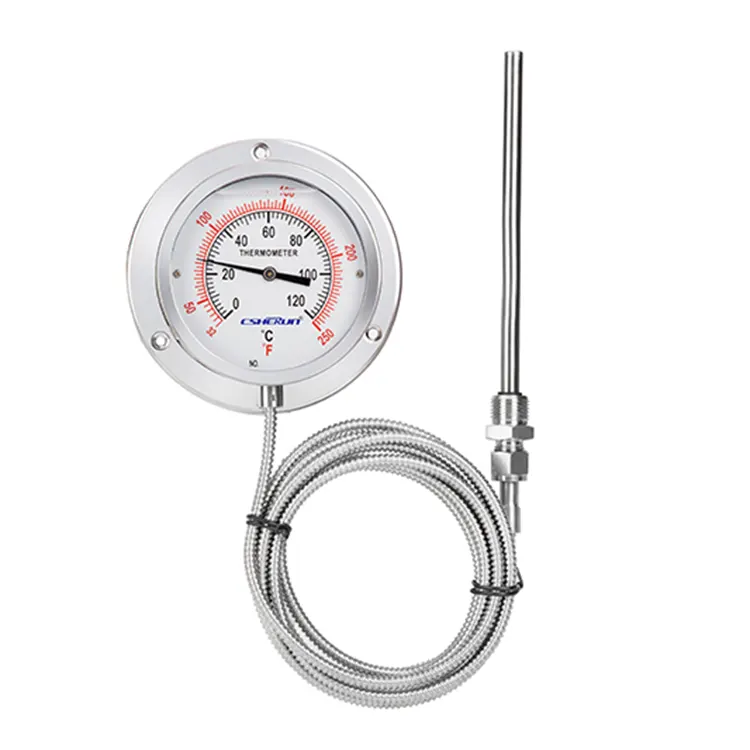
The Five Primary Failure Modes of a Pressure Type Temperature Gauge
| Failure Mode | Typical Cause | Early Warning Sign | Criticality Level |
|---|---|---|---|
| Loss of Fill Fluid (Leakage) | Corrosion, vibration loosening fittings, or capillary abrasion | Slow response time or erratic pointer movement | High – leads to total failure |
| Capillary Tube Damage | Kinking, crushing, or fatigue from repeated flexing | Gauge reads ambient temperature instead of process | High – often requires full replacement |
| Bourdon Tube Deformation | Over‑range pressure spikes or thermal shock | Permanent zero offset or non‑repeatable readings | Medium‑High – affects accuracy permanently |
| Sensor Bulb Coating/Fouling | Process fluid polymerization, scaling, or wax deposition | Gradual reading drift downward (insulation effect) | Medium – reversible with cleaning |
| Ambient Temperature Compensation Failure | Damaged bimetal compensator or improper installation | Reading changes when ambient room temperature fluctuates | Medium – can be misdiagnosed as process change |
Deep Dive into Each Failure Mode
1. Loss of Fill Fluid (Leakage)
The Pressure Type Temperature Gauge relies on a sealed, fluid‑filled system (gas, vapor, or liquid). Even a microscopic pinhole in the welded joint or at the capillary connection allows the filling medium to escape. For gas‑filled systems, pressure drops rapidly; for liquid‑filled systems, the gauge becomes sluggish. CSHERUN recommends routine helium leak testing for high‑integrity applications, especially in hydrogen or ammonia service where corrosion accelerates pitting.
2. Capillary Tube Mechanical Damage
The capillary is the gauge’s “nerve” – often running dozens of meters from the process to the panel. In practice, 40% of field failures at CSHERUN’s service centres trace back to capillary damage caused by maintenance personnel stepping on the tube, sharp bending near junction boxes, or abrasion against pipe supports. Once kinked, the internal volume changes, shifting the calibration curve permanently.
3. Bourdon Tube Over‑range Fatigue
The sensing element inside the gauge head is a C‑shaped or helical Bourdon tube. When process temperature spikes beyond the design span (e.g., steam hammer events), the tube wall undergoes plastic deformation. This produces a reproducible error – e.g., always reading 5 °C high – that cannot be adjusted out by the zero screw. CSHERUN offers over‑range stop options and snubbers to mitigate this risk.
4. Sensor Bulb Fouling
The bulb is immersed directly in the medium. In viscous fluids, bitumen, or polymerisation-prone processes, a coating layer acts as thermal insulation. The gauge then measures the coating’s surface temperature, not the true bulk temperature. Regular extraction and cleaning, or using a thermowell with a conductive paste, are proven countermeasures recommended by CSHERUN.
5. Ambient Temperature Effect Errors
Many users forget that the gauge head and part of the capillary are exposed to room conditions. A failing bimetal compensator (designed to offset ambient changes) leads to summer‑winter reading shifts of up to 2‑3% of span. CSHERUN‘s premium series features a dual‑compensator design that reduces this error to under 0.5% across a 0‑65 °C ambient range.
Pressure Type Temperature Gauge – FAQ Section
Q1: How can I distinguish between a faulty sensor bulb and a leaking capillary in my Pressure Type Temperature Gauge?
A: Perform a simple “isolation test”. Shut off the process and remove the bulb from the thermowell, then place it in an ice‑water bath (0 °C) and simultaneously in boiling water (100 °C) at sea level. Record the gauge response time. If the reading reaches 0 °C and 100 °C correctly but very slowly (over 2‑3 minutes), the bulb is likely fouled or the fill fluid viscosity has increased – but the system is sealed. If the reading never reaches those values and stays near ambient, that confirms a loss of fill fluid due to a capillary or joint leak. For a definitive diagnosis, CSHERUN recommends a pressure‑decay test using dry nitrogen on the empty system after evacuating the remaining fluid – this pinpoints the leak location within ±5 cm.
Q2: Can a Pressure Type Temperature Gauge be repaired after a Bourdon tube over‑range event, or must it be replaced entirely?
A: Replacement is almost always the only safe and cost‑effective option. The Bourdon tube is a precision‑formed spring element; once its elastic limit is exceeded, the material’s grain structure changes, creating hysteresis that no recalibration can eliminate. Some workshops attempt to “re‑bend” the tube, but this introduces unpredictable fatigue points and voids the manufacturer’s safety margin – especially critical in high‑pressure steam or hydrocarbon service. CSHERUN does not support field repair of the Bourdon element. Instead, we offer exchange units with a pre‑calibration certificate, so your replacement Pressure Type Temperature Gauge is ready to install within 15 minutes, minimising downtime. The failed unit can be returned for metallurgical analysis to prevent future over‑range incidents.
Q3: Why does my Pressure Type Temperature Gauge read correctly at room temperature but drift significantly when the process reaches 150 °C and above?
A: This classic symptom points to a failure in the ambient temperature compensation system combined with a mismatched fill fluid vapour‑pressure curve. At elevated temperatures, the total system pressure includes both the vapour pressure of the fill fluid and the thermal expansion pressure of the liquid phase. If the compensation bimetal is corroded or disconnected, the gauge head expands more than the calibration assumes, producing a positive drift (reading high). Additionally, if the gauge was filled with a general‑purpose fluid instead of a high‑temperature‑stabilised blend (e.g., silicone oil for >200 °C applications), the fluid’s coefficient of volumetric expansion changes non‑linearly above 150 °C. CSHERUN addresses this by offering three distinct fill formulations – low‑range, mid‑range, and high‑temperature – each with matched compensator springs. We advise checking your purchase order against the actual maximum operating temperature, and if you are already seeing this drift, a factory‑recalibration with the correct fluid and compensator replacement is required – a service we provide with a 48‑hour turnaround.
Preventive Maintenance Strategy – A Quick Checklist from CSHERUN
-
Visual inspection of capillary routing every 500 operating hours – look for chafing or sharp bends.
-
Annual calibration check using a dry‑block calibrator at three points (0 %, 50 %, 100 % of span).
-
Leak test all threaded connections with soap solution or electronic leak detector before each major turnaround.
-
Record ambient temperature at the gauge head simultaneously with process reading – flag deviations >1 %.
-
Replace the gauge if the zero point cannot be reset after the gauge has cooled to ambient conditions.
Final Word – And a Direct Call to Action
Identifying failure modes early is the difference between a scheduled maintenance event and a catastrophic process upset. The Pressure Type Temperature Gauge remains one of the most dependable thermometers in heavy industry, but only when its vulnerabilities – capillary damage, fluid loss, Bourdon tube fatigue, bulb fouling, and compensation drift – are actively managed. CSHERUN does not just sell gauges; we provide application‑specific failure‑mode analyses, custom fill fluids, and rapid exchange programs that keep your plant running.
Contact us today at CSHERUN – send your process data (temperature range, ambient conditions, vibration level, and medium type) to our engineering team. We will reply within 24 hours with a tailored recommendation, including a free failure‑mode risk assessment for your existing Pressure Type Temperature Gauges. Visit our website or reach out via the contact form – let us help you move from reactive repairs to predictive reliability.