

How Often Should You Calibrate a Portable pH ORP Meter for Reliable Readings
2026-07-08
For professionals in water treatment, agriculture, food processing, and environmental monitoring, the Portable pH ORP Meter is an indispensable field tool. Yet one question consistently arises: how often should you calibrate it to ensure data you can trust? The short answer depends on usage frequency, sample conditions, and electrode health. At DDK Scientific, we recommend a calibration schedule that balances precision with practicality—typically daily for high-precision work, weekly for routine monitoring, and always after any extreme measurement. Below, we break down the science and best practices.
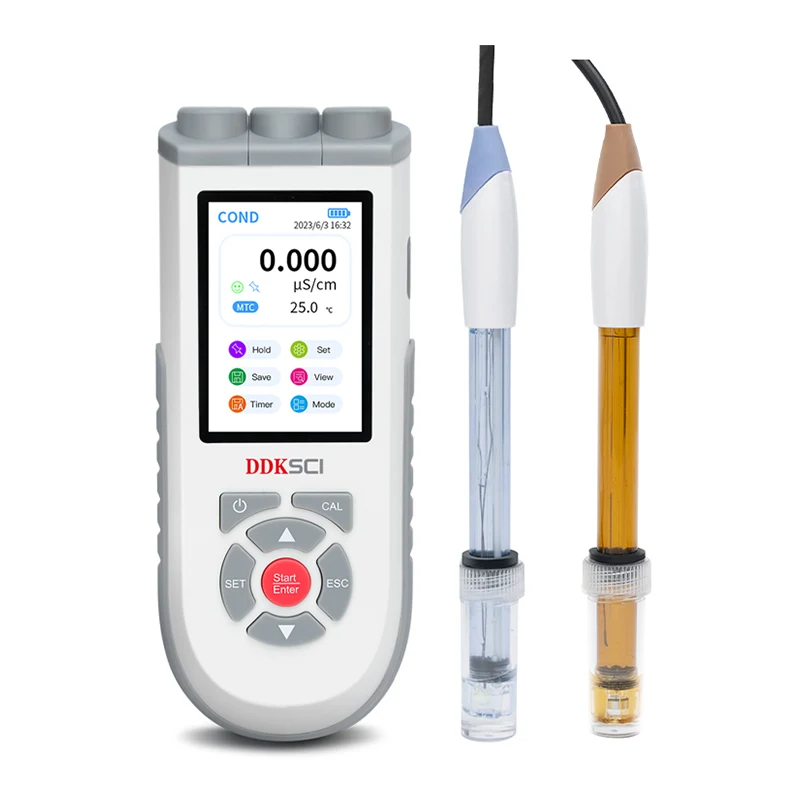
Why Calibration Frequency Matters More Than You Think
Calibration compensates for electrode drift—a natural phenomenon where the glass membrane and reference junction lose sensitivity over time. Without regular calibration, your Portable pH ORP Meter may produce readings with errors exceeding ±0.1 pH or ±20 mV, which can ruin batch consistency or misclassify water quality. The gold standard is 2-point calibration (pH 4.01 and 7.00) for acidic samples, or 3-point calibration (adding pH 10.01) for alkaline measurements. For ORP, a single-point check using a Zobell’s solution is often sufficient.
Recommended Calibration Intervals by Application
| Application Field | Recommended Frequency | Critical Trigger |
|---|---|---|
| Pharmaceutical / Biotech | Before every use (daily) | After measuring any solution with >1M salt |
| Drinking Water / Municipal | Every 2–3 days | After temperature change >5°C |
| Wastewater / Industrial Effluent | Weekly | After heavy metal or sulfide exposure |
| Hydroponics / Agriculture | Weekly (or before each nutrient batch) | After electrode storage >1 week dry |
| Food & Beverage (dairy, juice) | Daily | After measuring high-protein or oily samples |
| Field / Environmental Spot-Checking | Every 2 weeks | After dropping or bumping the probe |
5 Telltale Signs Your Portable pH ORP Meter Needs Immediate Calibration
Even if your calendar says "not yet," these symptoms demand an unscheduled calibration:
-
📉 Sluggish response – takes >30 seconds to stabilize.
-
🔄 Erratic readings – values jump even in a stirred buffer.
-
📊 Offset failure – the meter cannot recognize standard buffers during auto-calibration.
-
🌡️ Temperature mismatch – readings change unrealistically with a 1°C shift.
-
🧪 Known sample check – a fresh buffer reads outside ±0.05 pH from its labelled value.
Pro Tip from DDK Scientific: Always document your calibration results (slope and offset). A slope below 85% or above 105% indicates electrode aging—calibration won't fix that; replacement will.
Step-by-Step Best Practice for Calibration
-
Rinse the electrode with distilled water and blot dry (never wipe).
-
Immerse in fresh buffer (pH 7.00 first) and stir gently for 30 seconds.
-
Wait for the Portable pH ORP Meter to display a stable reading (usually 10–20 seconds).
-
Accept the point, then repeat for pH 4.01 (or 10.01).
-
Check ORP using a certified redox standard (e.g., 220 mV at 25°C).
-
Record slope, offset, and temperature—DDK Scientific meters store these logs internally for audit trails.
Frequently Asked Questions About Portable pH ORP Meter Calibration
Q1: Can I use expired buffer solutions to calibrate my Portable pH ORP Meter?
A: Absolutely not. Expired buffers have shifted pH values due to CO₂ absorption or microbial growth. Even a 0.03 pH error in the buffer translates to a 3–5% error in your sample readings. DDK Scientific advises using fresh, NIST-traceable buffers with a maximum shelf life of 3 months once opened. Always check the expiration date printed on the bottle. For ORP, redox standards are even more sensitive to light and oxygen—replace them every 2 months or when the colour changes.
Q2: How does temperature affect calibration frequency for a Portable pH ORP Meter?
A: Temperature changes the actual pH of buffers and the electrode’s Nernst slope (which is 59.16 mV/pH at 25°C, but varies with temperature). If your samples vary by more than ±5°C from the calibration temperature, you must either recalibrate at the sample temperature or use a meter with automatic temperature compensation (ATC). DDK Scientific integrates ATC in all our portable models, but even with ATC, we recommend a fresh 2-point calibration if the ambient temperature shifts by more than 10°C from your last session—because the reference junction potential also drifts with heat, and ATC cannot fully correct that physical change.
Q3: Is it necessary to calibrate the ORP channel as often as the pH channel on a Portable pH ORP Meter?
A: No. ORP electrodes are more stable over time because they are based on a platinum or gold surface that does not age in the same way as a pH glass membrane. For most industrial and environmental applications, calibrating ORP once a week or after every 50 measurements is sufficient—provided you use a fresh redox standard (e.g., Light’s solution or Zobell’s). However, DDK Scientific recommends a quick ORP check whenever you change the pH buffers, since it adds only 2 minutes and ensures both channels are traceable. The key exception: if you measure strong oxidizers (chlorine, ozone) or reducers (sulfides), calibrate ORP daily because these solutions can polarise the electrode surface.
Creating a Calibration Log That Supports EEAT (Experience, Expertise, Authoritativeness, Trustworthiness)
Google values content backed by documented evidence. DDK Scientific supplies a free digital calibration log template with every Portable pH ORP Meter purchase. A proper log should include:
-
Date & time
-
Buffer lot numbers and expiration
-
Slope (%) and offset (mV)
-
Ambient and sample temperature
-
Operator initials
-
Next calibration due date
This log not only satisfies ISO 9001 and GLP requirements but also builds trust with your auditors and customers.
Final Verdict: The "3-1-1" Rule from DDK Scientific
To simplify, we teach our users the 3-1-1 Rule:
-
3 days – maximum interval for critical/regulated samples.
-
1 day – calibrate if you used the meter for more than 2 hours continuously.
-
1 time – always calibrate after measuring a sample with extreme pH (<2 or >12), high temperature (>60°C), or heavy fouling.
Following this rule, your Portable pH ORP Meter will deliver lab-grade reliability in the field, reduce costly re-tests, and extend electrode life by up to 40%.
Need a Custom Calibration Schedule for Your Specific Process?
Every industry has unique matrix effects. Whether you test acidic mine drainage, alkaline cooling towers, or delicate fermentation broths, DDK Scientific offers free one-on-one consultation to design a tailored calibration protocol for your Portable pH ORP Meter.
📧 Contact us today or visit our website to download our complete calibration SOP and electrode maintenance guide. Our technical team responds within 4 business hours—because reliable readings start with the right routine. Let’s calibrate your success together.