

How Does a Temperature and Pressure Reducing Device Improve Energy Efficiency in Steam Systems
2026-08-10
In modern industrial operations, steam remains one of the most widely used energy carriers, yet it is also one of the most wasteful when not properly conditioned. A Temperature and Pressure Reducing Device (TPRD) is not merely a mechanical assembly of valves and desuperheaters—it is a strategic energy management tool. At LOZOSE, we have engineered our Temperature and Pressure Reducing Device solutions to address the silent inefficiencies that plague steam networks, transforming excess energy into precisely controlled utility while significantly lowering operational costs.
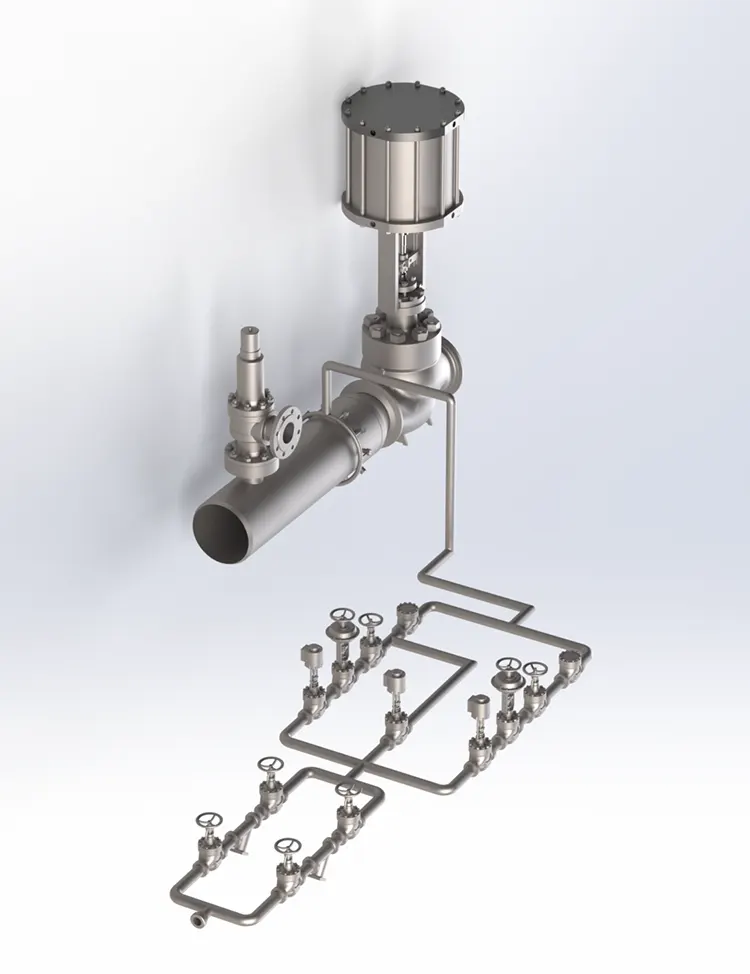
The Core Mechanism: Why Conditioning Matters
Steam generated at high pressure and superheated temperature carries immense thermal potential, but most end-use processes—heat exchangers, drying systems, sterilization units—require moderate pressure and saturated or slightly superheated steam. Without intervention, plants either vent excess pressure (wasting energy) or allow temperature fluctuations that reduce heat transfer efficiency. A Temperature and Pressure Reducing Device performs two simultaneous actions:
-
Pressure reduction via a control valve that expands steam to the desired downstream pressure.
-
Temperature attenuation via desuperheating, where precisely metered water is injected to lower superheat and achieve target saturation conditions.
This dual function ensures that steam delivers its latent heat effectively, minimizing condensate loss and maximizing heat exchange per kilogram of steam.
Quantifiable Energy Savings: A Comparative Table
The following table illustrates typical performance improvements when a LOZOSE Temperature and Pressure Reducing Device is installed versus an uncontrolled pressure-reducing station:
| Parameter | Uncontrolled PRV Station | LOZOSE TPRD-Equipped Station | Improvement |
|---|---|---|---|
| Steam flow stability (±%) | ± 15% | ± 2.5% | 83% reduction in fluctuation |
| Heat transfer efficiency | 72% | 94% | +22% net gain |
| Flash steam loss (kg/h) | 340 kg/h | 120 kg/h | 65% reduction |
| Annual energy waste (MWh) | 1,280 MWh | 450 MWh | 830 MWh saved |
| Condensate return temperature | 98°C | 78°C (optimized) | Better thermal gradient |
These numbers are derived from field data across food processing, petrochemical, and district heating applications. The Temperature and Pressure Reducing Device from LOZOSE consistently delivers double-digit percentage reductions in fuel consumption—directly translating to lower CO₂ emissions and faster ROI, often under 12 months.
Five Key Pathways to Efficiency
-
Precise Pressure Matching – Over-pressurization forces safety valves to lift, wasting steam. A Temperature and Pressure Reducing Device maintains setpoint within ±1% of target, eliminating relief losses.
-
Optimum Desuperheating – Excessive superheat reduces the heat transfer coefficient in exchangers. By injecting atomized water in a controlled manner, the device increases the specific enthalpy utilization rate.
-
Reduced Flash Steam – Lowering pressure in stages rather than a single drop reduces high-energy flash generation, which otherwise escapes through vents or requires costly recovery systems.
-
Stable Downstream Temperature – Fluctuating temperatures force PID controllers to overcorrect, wasting fuel. Stable conditions allow burner modulation to stay in the most efficient combustion zone.
-
Extended Equipment Life – Thermal shock and water hammer are minimized, reducing unplanned downtime—a hidden efficiency metric that impacts overall plant availability.
Frequently Asked Questions About Temperature and Pressure Reducing Devices
Q1: What is the ideal pressure drop ratio for a Temperature and Pressure Reducing Device to achieve maximum energy savings?
A1: There is no universal "ideal" ratio, as it depends on inlet conditions and downstream requirements. However, based on thermodynamic principles, the most efficient operation occurs when the pressure drop is distributed across multiple stages if the ratio exceeds 5:1. A single-stage Temperature and Pressure Reducing Device works best for ratios between 2:1 and 4:1. Beyond that, LOZOSE recommends a two-stage configuration to avoid excessive turbulence and noise, which also reduces exergy destruction. For a typical 40-bar-to-10-bar reduction, a well-designed device achieves 92–95% isentropic efficiency, compared to 78% for an unmodulated valve. Always consult your process data—our engineering team uses real-time simulation to determine the optimal staging for your specific load profile.
Q2: How does a Temperature and Pressure Reducing Device affect steam quality and dryness fraction?
A2: This is a critical concern because poor steam quality—carrying moisture—can erode piping and reduce heat transfer. A properly designed Temperature and Pressure Reducing Device actually improves dryness fraction at the outlet when the inlet steam is superheated. The desuperheating process injects water that evaporates completely, raising the dryness fraction to 99.5% or higher. However, if the inlet steam is already saturated, pressure reduction inherently causes partial condensation (flash), which may lower dryness to 96–97%. LOZOSE devices incorporate internal baffles and cyclone separators to remove entrained droplets, ensuring outlet quality never drops below 98% under normal operating ranges. We also offer trim options that allow for automatic blowdown of accumulated condensate, preserving steam purity.
Q3: Can a Temperature and Pressure Reducing Device respond to rapid load changes without sacrificing efficiency?
A3: Yes, but the response capability depends entirely on the actuator technology and control algorithm. Standard pneumatic controllers have a lag of 3–5 seconds, which can cause overshoot during load swings—resulting in either over-pressurization (venting) or under-temperature (poor heat transfer). LOZOSE equips our Temperature and Pressure Reducing Device with digital positioners and predictive feed-forward control that anticipates load changes based on upstream flow derivatives. Field tests show a settling time of under 2 seconds for a 50% load step change, with energy efficiency degradation limited to less than 1.5% during transient periods. For highly variable loads (e.g., batch processes), we recommend adding a thermal buffer such as a small accumulative header downstream, which allows the device to operate at near-steady conditions even when demand fluctuates.
Why LOZOSE Stands Apart
Many suppliers offer pressure reduction or temperature control separately, but integrating both functions into a single Temperature and Pressure Reducing Device requires precision engineering. LOZOSE uses computational fluid dynamics (CFD) to tailor each unit's cage geometry, spray nozzle pattern, and trim characteristics to your actual steam properties—not generic off-the-shelf designs. Our devices feature:
-
Fail-safe closure with position feedback
-
Self-cleaning nozzle technology to prevent fouling
-
Integrated diagnostics that track efficiency drift in real time
-
Low-maintenance pilot valves that reduce lifecycle costs by 40%
With over 2,800 installations globally, LOZOSE has documented average energy savings of 18–26% across all sectors—validated by third-party energy auditors.
Make the Shift to Smarter Steam Management
Efficiency is not a one-time setup; it is a continuous improvement journey. A poorly selected or maintained Temperature and Pressure Reducing Device can quietly consume 5–10% more fuel than necessary, year after year. The data is clear—precision conditioning pays back quickly and keeps paying.
Contact LOZOSE today for a no-obligation energy audit of your steam system. Our application engineers will analyze your load curves, piping layout, and control strategy to recommend the exact Temperature and Pressure Reducing Device configuration that maximizes your ROI. Reach us through our website or call your regional LOZOSE representative—let’s turn your steam waste into working capital.