Article Summary
Accurate pressure measurement is essential in industries where even small pressure variations can influence safety, efficiency, and product quality. A capsule pressure gauge is specifically designed for measuring low-pressure gases and air pressure with high sensitivity and reliability. This article explains how capsule pressure gauges work, why they are important, how to select the right model, and how they help solve common measurement challenges in industrial applications. By understanding their structure, advantages, and maintenance requirements, users can make better decisions when choosing pressure measurement equipment for their systems.
Article Outline
|
Section
|
Main Content
|
|
Introduction
|
The importance of accurate low-pressure measurement and the role of capsule pressure gauges
|
|
Working Principle
|
Structure, sensing mechanism, and pressure conversion process
|
|
Industrial Challenges
|
How capsule pressure gauges solve measurement accuracy and reliability issues
|
|
Applications
|
Industries that benefit from capsule pressure measurement technology
|
|
Selection Guide
|
Important factors when purchasing a suitable gauge
|
|
Maintenance
|
Methods to extend service life and maintain accuracy
|
What Is a Capsule Pressure Gauge?
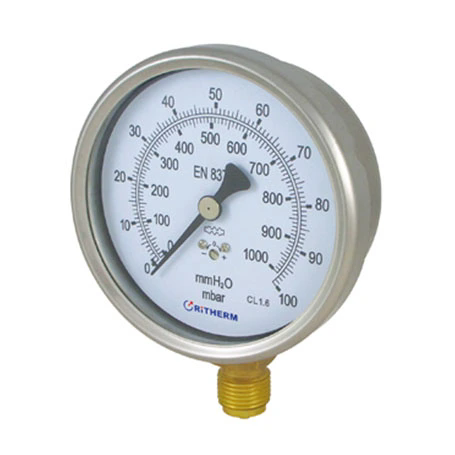
A capsule pressure gauge is a precision instrument designed to measure very low pressures, vacuum pressures, and differential pressures in gas systems. Unlike conventional pressure gauges that rely on Bourdon tubes, capsule pressure gauges use a flexible capsule sensing element that expands or contracts according to pressure changes.
The capsule structure provides excellent sensitivity because it can detect small pressure variations that may not be easily measured by standard mechanical gauges. This makes it especially suitable for applications involving clean gases, ventilation systems, filtration equipment, and laboratory environments.
The core purpose of a capsule pressure gauge is to provide operators with reliable pressure information while maintaining stable performance under demanding operating conditions. For industries requiring precise low-pressure monitoring, selecting a high-quality instrument is essential.
How Does a Capsule Pressure Gauge Work?
The operating principle of a capsule pressure gauge is based on the elastic deformation of a metal capsule. When pressure enters the measuring chamber, the capsule element moves slightly. This mechanical movement is transferred through a linkage mechanism to the pointer, allowing users to read the pressure value directly from the dial.
|
Component
|
Function
|
|
Capsule Element
|
Detects small pressure changes through expansion and contraction
|
|
Movement Mechanism
|
Transfers capsule movement into pointer rotation
|
|
Dial Display
|
Shows measured pressure values clearly
|
|
Housing
|
Protects internal components from environmental influence
|
Because the sensing element is highly responsive, capsule pressure gauges can accurately measure pressure ranges that are too low for many traditional gauges. This allows engineers to monitor systems where precise pressure control is critical.
What Problems Can a Capsule Pressure Gauge Solve?
Many industrial systems face challenges when measuring extremely low pressure. Incorrect readings can lead to inefficient operation, equipment damage, or safety risks. A capsule pressure gauge helps solve these problems through sensitive measurement and dependable mechanical performance.
-
Low Pressure Measurement Difficulty: Traditional gauges may not respond effectively to very small pressure changes, while capsule designs provide higher sensitivity.
-
Unstable Monitoring Results: High-quality capsule pressure gauges provide consistent readings and reduce measurement errors.
-
Equipment Protection Issues: Accurate pressure monitoring helps prevent abnormal operating conditions.
-
Maintenance Challenges: Durable construction reduces replacement frequency and improves system reliability.
-
Limited Application Flexibility: Capsule pressure gauges are suitable for many gas measurement environments.
For companies requiring dependable pressure monitoring solutions, Ritherm provides professionally designed capsule pressure gauge products that focus on measurement accuracy, durability, and application flexibility.
Where Are Capsule Pressure Gauges Commonly Used?
Capsule pressure gauges are widely applied in industries where precise low-pressure monitoring is necessary. Their sensitive measurement capability makes them valuable in various technical environments.
|
Industry
|
Application Examples
|
Benefits
|
|
HVAC Systems
|
Air pressure monitoring and ventilation control
|
Improves airflow management and system efficiency
|
|
Medical Equipment
|
Gas pressure monitoring devices
|
Provides accurate low-pressure readings
|
|
Laboratory Equipment
|
Testing and research instruments
|
Supports precise experimental conditions
|
|
Industrial Automation
|
Pneumatic control systems
|
Helps maintain stable operation
|
|
Environmental Equipment
|
Filtration and air treatment systems
|
Ensures reliable pressure monitoring
|
How to Choose the Right Capsule Pressure Gauge?
Selecting the correct capsule pressure gauge requires careful consideration of operating conditions, measurement requirements, and installation environments. The following factors can help users choose the most suitable solution.
-
Pressure Range: Select a gauge with a suitable measurement range. Choosing an incorrect range may reduce accuracy or damage the instrument.
-
Medium Compatibility: Confirm that the gauge materials are suitable for the measured gas or pressure medium.
-
Accuracy Requirement: Different applications require different precision levels. Critical systems should use higher accuracy models.
-
Installation Method: Consider mounting position, connection size, and installation space before selection.
-
Environmental Conditions: Temperature, vibration, and humidity may influence gauge performance.
A professional manufacturer can provide technical support to help customers select a suitable model according to their specific application requirements.
Capsule Pressure Gauge vs Traditional Pressure Gauges
|
Feature
|
Capsule Pressure Gauge
|
Traditional Pressure Gauge
|
|
Measurement Range
|
Excellent for low-pressure applications
|
Usually designed for medium or high pressure
|
|
Sensitivity
|
High sensitivity for small pressure changes
|
Lower sensitivity in very low pressure conditions
|
|
Application
|
Gas systems, HVAC, laboratories
|
General industrial pressure measurement
|
|
Measurement Stability
|
Reliable for precision monitoring
|
Depends on operating conditions
|
The choice between different pressure measurement technologies depends on the actual application. For low-pressure gas measurement, capsule pressure gauges usually provide better performance and more accurate results.
Maintenance Tips for Long-Term Performance
Proper maintenance can significantly extend the service life of a capsule pressure gauge and ensure accurate readings throughout operation.
-
Regularly inspect the gauge for physical damage or abnormal movement.
-
Keep the pressure connection clean and free from blockage.
-
Avoid exposing the gauge to pressure levels beyond its rated range.
-
Check calibration periodically according to operating requirements.
-
Install the gauge correctly to minimize vibration impact.
Routine inspection allows operators to identify potential problems early and maintain reliable measurement performance.
Frequently Asked Questions About Capsule Pressure Gauges
Q1: What pressure range can a capsule pressure gauge measure?
A capsule pressure gauge is mainly designed for low-pressure measurement. The exact range depends on the product design and manufacturer specifications.
Q2: Why is a capsule pressure gauge more sensitive than a standard gauge?
The flexible capsule sensing element can detect small pressure changes, making it more suitable for applications requiring precise low-pressure monitoring.
Q3: Can capsule pressure gauges measure liquids?
Most capsule pressure gauges are primarily designed for gas measurement. Application suitability depends on the specific model and material compatibility.
Q4: How often should a capsule pressure gauge be calibrated?
Calibration frequency depends on operating conditions, industry requirements, and accuracy expectations. Regular calibration helps maintain measurement reliability.
Q5: Why choose Ritherm for capsule pressure gauge solutions?
Ritherm focuses on providing reliable pressure measurement products with attention to accuracy, durability, and customer application requirements. Professional manufacturing and technical experience help customers achieve stable pressure monitoring performance.
Conclusion
A capsule pressure gauge is an effective solution for industries that require accurate low-pressure measurement. Its sensitive capsule sensing technology, stable performance, and wide application range make it an important instrument for monitoring gas pressure systems.
By understanding the working principle, advantages, applications, and selection considerations, users can choose a pressure measurement solution that improves operational efficiency and reduces potential risks. Reliable pressure monitoring is not only about obtaining a reading but also about maintaining safer and more efficient industrial processes.
If you are looking for a dependable capsule pressure gauge with professional technical support and customized solutions, Ritherm is ready to provide high-quality products that meet your application needs. Contact us today to discuss your pressure measurement requirements and find the right solution for your system.