

How Does a Bimetal Thermometer Work?
2026-03-19
Abstract: Bimetal thermometers are widely used across industrial, commercial, and residential applications due to their durability, simplicity, and cost-effectiveness. This article explains how a bimetal thermometer works, highlights its key components, explores practical applications, and addresses common customer concerns such as accuracy, installation, and maintenance. A structured overview, product parameter table are included to support informed purchasing decisions.
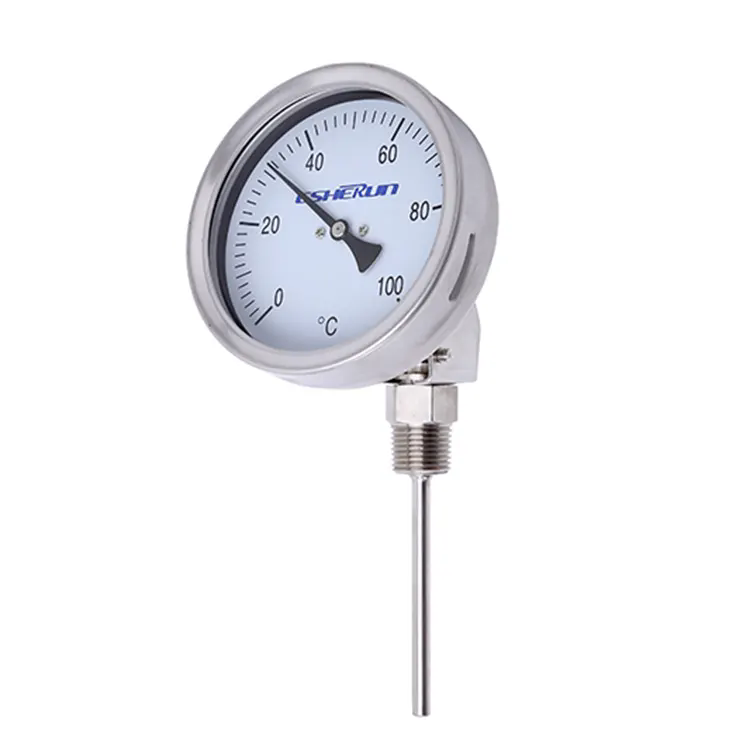
Table of Contents
- 1. Overview of Bimetal Thermometers
- 2. How Does a Bimetal Thermometer Work?
- 3. Key Components and Structure
- 4. Advantages and Limitations
- 5. Typical Applications
- 6. Product Parameters
- 7. How to Choose the Right Model
- 8. Maintenance and Calibration Tips
- 9. Frequently Asked Questions
1. Overview of Bimetal Thermometers
A bimetal thermometer is a mechanical temperature measuring device that uses two different metals bonded together to detect temperature changes. Due to its robust structure and independence from external power sources, it is widely used in industrial environments such as pipelines, boilers, HVAC systems, and food processing equipment.
Customers often choose this type of thermometer when they need a reliable and low-maintenance solution for real-time temperature monitoring.
2. How Does a Bimetal Thermometer Work?
The working principle is based on the thermal expansion difference between two metals. When exposed to temperature changes, each metal expands at a different rate. This creates a bending motion.
This mechanical movement is converted into rotational motion, which drives the pointer on the dial to indicate temperature.
- Two metals are bonded together into a strip or coil
- Temperature changes cause uneven expansion
- The strip bends or twists accordingly
- The movement is transmitted to a pointer
- The dial displays the temperature reading
In most designs, the bimetal strip is formed into a spiral or helical coil to enhance sensitivity and accuracy.
3. Key Components and Structure
A standard bimetal thermometer consists of several critical parts:
- Sensing Element: The bimetal strip or coil
-
-
-
-
The structure is designed for durability, allowing the device to perform reliably in harsh environments such as high humidity, vibration, and pressure conditions.
4. Advantages and Limitations
Understanding both strengths and limitations helps users make informed decisions.
Advantages:
- No external power required
- Simple and rugged construction
- Cost-effective solution
- Suitable for harsh environments
- Easy installation and maintenance
Limitations:
- Lower precision compared to digital sensors
- Slower response time
- Limited remote monitoring capability
5. Typical Applications
Bimetal thermometers are used in a wide range of industries:
- Oil and gas pipelines
- Chemical processing plants
- HVAC systems
- Food and beverage equipment
- Boilers and heat exchangers
They are especially suitable for applications where durability and reliability are more important than ultra-high precision.
6. Product Parameters
| Parameter | Description |
|---|---|
| Temperature Range | -50°C to 600°C (customizable) |
| Accuracy | ±1% to ±2% of full scale |
| Dial Diameter | 60mm, 100mm, 150mm |
| Stem Length | 50mm to 1000mm |
| Material | Stainless Steel (SS304/SS316) |
| Mounting Type | Radial, axial, adjustable angle |
7. How to Choose the Right Model
Customers often face challenges when selecting the correct bimetal thermometer. The following criteria should be evaluated:
- Temperature Range: Ensure compatibility with operating conditions
- Installation Type: Choose based on equipment orientation
- Stem Length: Match insertion depth requirements
- Dial Size: Consider readability from a distance
- Material Compatibility: Ensure resistance to corrosion
Choosing the wrong specification may lead to inaccurate readings or reduced product lifespan.
8. Maintenance and Calibration Tips
Although bimetal thermometers require minimal maintenance, regular checks can improve performance:
- Inspect for mechanical damage or corrosion
- Verify calibration periodically
- Avoid exposure to extreme vibration
- Clean the probe to ensure proper heat transfer
Calibration can be performed using a controlled temperature bath or reference thermometer.
9. Frequently Asked Questions
Q1: How accurate is a bimetal thermometer?
A: Typically, accuracy ranges between ±1% and ±2% of the full scale, depending on the model and operating conditions.
Q2: Can it be used in high-pressure environments?
A: Yes, especially when designed with reinforced stems and protective thermowells.
Q3: Does it require power supply?
A: No, it operates entirely on mechanical principles, making it ideal for remote or hazardous locations.
Q4: How often should calibration be done?
A: It depends on usage, but generally every 6 to 12 months for critical applications.
Conclusion
Bimetal thermometers provide a dependable and cost-efficient solution for temperature measurement in a variety of industrial environments. Their mechanical simplicity, durability, and ease of use make them a preferred choice for many applications where reliability is critical.
As a professional manufacturer, CSHERUN offers a wide range of high-quality bimetal thermometers designed to meet diverse operational requirements. From customizable specifications to robust construction, these products are engineered for long-term performance.
If you are looking for a reliable temperature measurement solution tailored to your needs, contact us today to explore how CSHERUN can support your project with precision-engineered products and professional service.