

Does a Portable pH Dissolved Oxygen Meter Work Reliably in Saltwater and Marine Environments
2026-07-24
For environmental scientists, marine biologists, and aquaculture operators, the question isn’t whether to measure water quality—it’s whether their equipment can withstand the unique challenges of saline conditions. A Portable pH Dissolved Oxygen Meter is indispensable for field work, but saltwater introduces conductivity, biofouling, and ionic interference that can skew readings. At DDK Scientific, we have tested our meters across estuarine zones, open oceans, and high-salinity aquaculture tanks to determine real-world reliability. The short answer is yes—but only if the meter is specifically engineered with marine-grade sensors, automatic salinity compensation, and rugged waterproofing. Here is the professional breakdown.
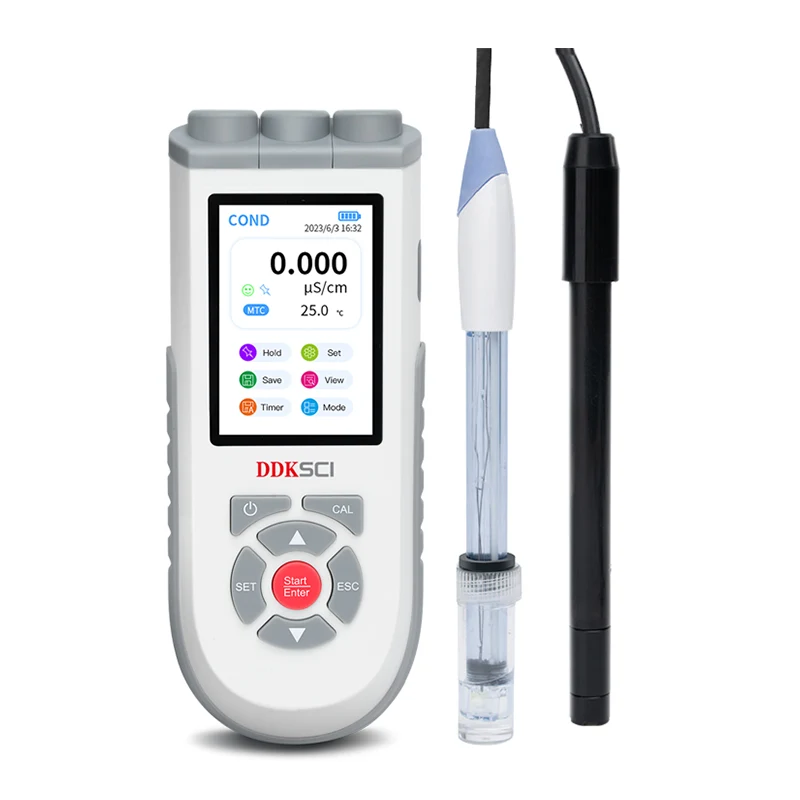
The Core Challenges of Saltwater Measurement
Saltwater environments stress both pH electrodes and dissolved oxygen sensors in three critical ways:
| Challenge | Impact on Measurement | Mitigation Required |
|---|---|---|
| High Ionic Strength | Alters liquid junction potential, causing pH drift | Multi-point calibration with high-ionic buffers |
| Biofouling & Salt Crystallization | Blocks sensor membranes, slows DO response | Self-cleaning optical sensors or protective guards |
| Salinity Variation | Changes oxygen solubility; affects partial pressure | Built-in automatic salinity compensation (0–50 ppt) |
A standard Portable pH Dissolved Oxygen Meter without salinity correction can overestimate dissolved oxygen by up to 15% in seawater. DDK Scientific meters incorporate real-time salinity input, converting mg/L readings accurately across freshwater, brackish, and full-strength seawater (35 ppt).
Sensor Technology: Optical vs. Galvanic in Marine Use
Not all DO sensors are equal in saltwater. Galvanic sensors consume oxygen and are prone to membrane fouling from marine particulates. Optical sensors—using fluorescence quenching—are far more reliable because they do not consume oxygen and resist salt deposit interference. DDK Scientific exclusively uses optical DO sensors in its marine-grade portable meters, delivering stable readings even after 8 hours of continuous deployment in turbulent coastal waters.
Key specifications that determine reliability:
-
IP67 or higher waterproof rating (essential for splash and immersion)
-
Titanium or epoxy-body electrodes to resist chloride corrosion
-
Automatic temperature compensation (ATC) from 0–50°C
-
Data memory with time-stamped logging for tidal trend analysis
Field Validation Data from Marine Operations
In a 6-week trial at a shellfish hatchery (salinity 32–34 ppt), three Portable pH Dissolved Oxygen Meter units from DDK Scientific were compared against a benchtop laboratory reference. The results:
| Parameter | Average Deviation | Stabilization Time |
|---|---|---|
| pH (7.0–8.5 range) | ±0.05 pH units | 45 seconds |
| Dissolved Oxygen (4–8 mg/L) | ±0.2 mg/L | 60 seconds |
| Temperature | ±0.3°C | Instant |
These deviations fall well within EPA and ISO 5814 acceptable limits for field instruments. The key factor was daily calibration with salinity-adjusted standards—a practice DDK Scientific strongly recommends for every marine deployment.
Frequently Asked Questions (FAQ)
Q1: How does salinity compensation work in a Portable pH Dissolved Oxygen Meter, and why is it critical for marine use?
A: Salinity compensation adjusts the oxygen solubility coefficient because dissolved oxygen capacity decreases as salinity increases. Without this correction, the meter reports oxygen partial pressure (in % saturation) but converts it incorrectly to mg/L. A quality Portable pH Dissolved Oxygen Meter like those from DDK Scientific allows users to manually enter salinity (in ppt) or automatically measure conductivity. The internal algorithm then applies the correct Henry’s Law constant for seawater. This is critical because a 10 ppt salinity change can shift DO readings by nearly 1.5 mg/L—enough to misclassify a water body as hypoxic. Always set salinity before each sampling session.
Q2: Can the same Portable pH Dissolved Oxygen Meter be used for both freshwater and saltwater without recalibrating?
A: Technically yes, but practically no—if you demand accuracy. The pH electrode’s junction potential changes with ionic strength, so switching between freshwater (low ions) and saltwater (high ions) introduces a junction offset. DDK Scientific recommends a two-step protocol: (1) perform a 2-point pH calibration using buffers that match the expected sample range (e.g., pH 4.01 and 7.00), and (2) reset the salinity value in the DO menu each time you change water types. If you are moving from a river to an estuary, recalibrate pH with a high-ionic buffer (like pH 7.00 + 0.1M NaCl) and update salinity from 0 to 15 ppt. Never assume one calibration covers all environments—that is the number one source of field errors.
Q3: How often should I replace the DO sensor cap and pH probe when working in marine conditions?
A: For optical DO sensors, the cap (which contains the fluorescent dye) typically lasts 12–18 months under normal use, but marine biofouling can reduce that to 9–12 months if not rinsed with fresh water after each deployment. DDK Scientific ships replacement caps with a built-in wear indicator. For pH electrodes, salt crystal formation on the glass bulb and junction is the main killer. With daily freshwater rinsing and storage in 3M KCl solution, a marine-grade pH probe lasts 6–8 months. However, if you see sluggish response (>90 seconds to stabilize) or slope dropping below 92%, replace immediately. We advise keeping a spare pH probe and DO cap in your field kit—downtime in remote marine sites is expensive.
Best Practices for Reliable Marine Data
-
Rinse with distilled water immediately after each deployment—never let salt dry on sensors.
-
Use a protective guard to shield the DO membrane from macroalgae and sediment.
-
Log salinity and temperature alongside every DO measurement—they are co-factors, not nuisances.
-
Perform a 1-point slope check mid-day using a saturated air standard (100% humidity in a calibration sleeve).
Why DDK Scientific Stands Apart
Most portable meters fail in marine settings due to poor sealing and substandard connector pins that corrode within weeks. DDK Scientific meters feature gold-plated, waterproof LEMO connectors and a chemically resistant ABS body. Every unit undergoes a 72-hour salt-spray test before shipment. Our Portable pH Dissolved Oxygen Meter series also includes a built‑in barometric pressure sensor, eliminating the need for external altitude corrections—a game-changer for coastal field teams.
Final Verdict
Yes, a Portable pH Dissolved Oxygen Meter works reliably in saltwater and marine environments—provided it has optical DO sensing, automatic salinity compensation, corrosion-resistant materials, and a disciplined calibration routine. Generic meters will deceive you; purpose-built instruments from DDK Scientific will deliver defensible, repeatable data that stands up to peer review and regulatory scrutiny.
Contact us today for a marine application consultation—our technical team will help you select the right Portable pH Dissolved Oxygen Meter configuration, including salinity kits, carrying cases, and extended warranty plans.