

Can a Stainless Steel Capsule Pressure Gauge Be Used for Corrosive Environments
2026-06-10
Selecting the right pressure measurement instrument for aggressive media is a common engineering challenge. A Stainless Steel Capsule Pressure Gauge is often considered, but is it truly suitable for corrosive environments? The short answer is yes—but with specific conditions. At CSHERUN, we engineer these gauges to withstand a wide range of corrosive conditions, provided the wetted parts are correctly matched to the medium.
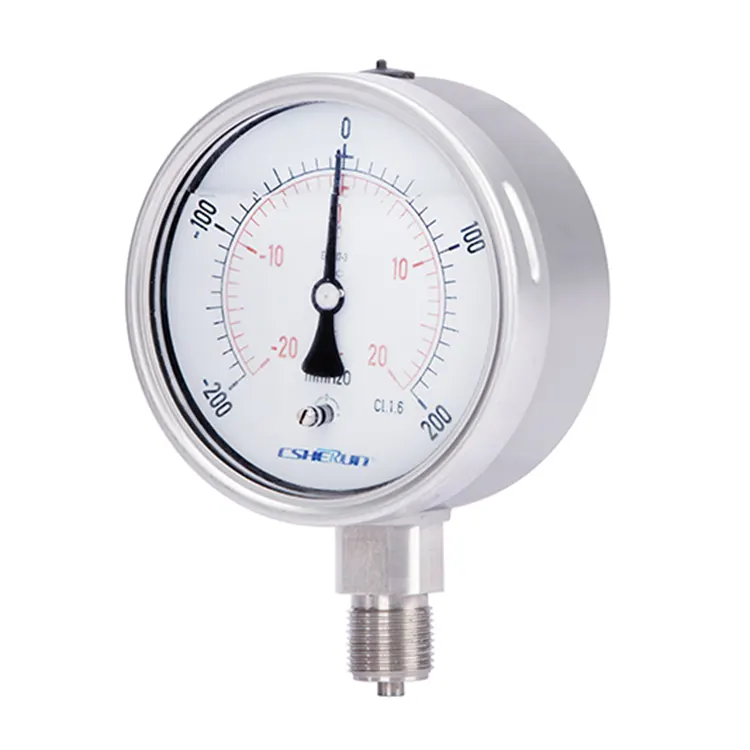
Key Construction Features
The corrosion resistance of a Stainless Steel Capsule Pressure Gauge depends on material selection and design:
| Component | Standard Material | Corrosion-Resistant Option |
|---|---|---|
| Capsule (wetted) | SS304 | SS316L, Hastelloy, Monel |
| Case | SS304 | SS316, fiberglass-reinforced plastic |
| Connection thread | SS304 | SS316L with PTFE seal |
| Window | Polycarbonate | Laminated safety glass |
When Is It Safe to Use?
A Stainless Steel Capsule Pressure Gauge excels in low-pressure gas or liquid applications (0–60 kPa typical). It resists atmospheric corrosion and mild chemical exposure. However, for highly acidic or chloride-rich environments (e.g., seawater, HCl vapor), standard SS304 may pit or crack. CSHERUN recommends upgrading to SS316L or exotic alloys for long-term reliability.
List of Compatible vs. Incompatible Media
Compatible with SS316L capsule:
-
Dilute acids (acetic, phosphoric)
-
Alkaline solutions (NaOH up to 10%)
-
Seawater (limited pitting risk)
-
Most hydrocarbons
Not compatible without special alloys:
-
Hydrochloric acid >5%
-
Sulfuric acid >10%
-
Chlorine gas (wet)
-
Ferric chloride solutions
FAQ: Stainless Steel Capsule Pressure Gauge
Q1: Can a Stainless Steel Capsule Pressure Gauge measure corrosive gases like chlorine?
A: For dry chlorine gas at ambient temperature, a Stainless Steel Capsule Pressure Gauge with a CSHERUN Hastelloy C276 capsule and PTFE-coated case is acceptable. However, wet chlorine creates hydrochloric acid, which rapidly attacks standard stainless steel. Always verify gas moisture content. We offer custom purge ports to prevent condensation inside the gauge.
Q2: How does CSHERUN seal the capsule to prevent corrosive ingress?
A: CSHERUN uses laser-welded capsule seams and a diaphragm seal interface when needed. The capsule itself is hermetically sealed, and the movement is isolated from the pressure chamber by a PTFE O-ring. For severe environments, we add a silicone oil fill (case filling) to stop vapors from reaching internal steel parts. This extends gauge life by 3–5 times compared to unfilled units.
Q3: What maintenance does a stainless steel capsule gauge need in corrosive service?
A: Even a high-grade Stainless Steel Capsule Pressure Gauge requires quarterly inspections: check for case pitting, window etching, and zero drift. For CSHERUN gauges in acidic vapor service, flush the connection monthly with deionized water if allowed. Replace any gauge showing discoloration around the welding points. Storage in dry nitrogen-purged bags during downtime prevents crevice corrosion.
Practical Recommendations
| Environment | Recommended CSHERUN Model | Max Pressure | Capsule Material |
|---|---|---|---|
| Mild chemical plant | SS-CAP-304 | 30 kPa | SS304 |
| Pulp & paper (chlorine dioxide) | SS-CAP-316L | 25 kPa | SS316L |
| Offshore platform | SS-CAP-HC | 60 kPa | Hastelloy C276 |
| Pharmaceutical (pure steam) | SS-CAP-PS | 40 kPa | SS316L electropolished |
Conclusion
A Stainless Steel Capsule Pressure Gauge can handle corrosive environments if the capsule material, case protection, and seal design are properly specified. CSHERUN provides full chemical compatibility charts and custom alloy options. Avoid standard SS304 for wet chlorine or strong mineral acids.
Contact us at CSHERUN for a corrosion assessment. Our engineers will match the exact Stainless Steel Capsule Pressure Gauge to your medium, temperature, and cycle life requirements. Reach out via our website or email to request a free material selection checklist and quote. Your process safety is our priority.