

Can a 4P Single Phase LCD Din Rail Energy Meter Be Used with a CT Coil
2026-07-15
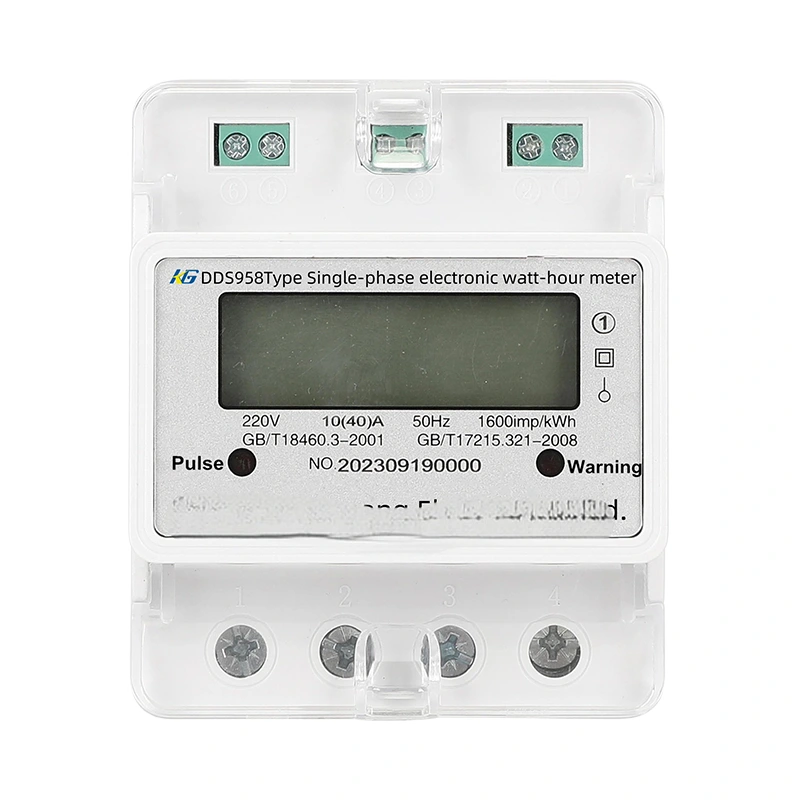
For electrical engineers, facility managers, and solar installers, the question of compatibility between a 4P Single Phase LCD Din Rail Energy Meter and a current transformer (CT coil) is not just technical—it is practical. The short answer is yes, but the execution requires careful attention to meter type, CT ratio, burden, and wiring polarity. SINGI, a brand known for reliable DIN-rail measurement solutions, offers 4P Single Phase LCD Din Rail Energy Meter models that explicitly support external CT coils, making them ideal for high-current circuits where direct connection is impossible or unsafe.
Why Use a CT Coil with This Meter?
Directly connecting a meter to circuits above 80A typically demands thicker conductors and larger terminals. A CT coil scales down the primary current to a standardized secondary signal (e.g., 5A or 1A), allowing the 4P Single Phase LCD Din Rail Energy Meter to measure safely and accurately. Key benefits include:
-
Safety: Isolation from high-voltage/high-current lines.
-
Flexibility: Measure busbars or large cables without cutting them.
-
Cost-effectiveness: One meter can cover multiple CT ratios (e.g., 100/5A, 200/5A) by reprogramming the multiplier.
Critical Compatibility Checklist
Not every 4P Single Phase LCD Din Rail Energy Meter works with CTs. Below is a practical selection guide based on SINGI’s product specifications:
| Parameter | Requirement for CT Use | SINGI Compliance |
|---|---|---|
| Input type | Separate CT input terminals (S1, S2) | Yes (models with S1/S2) |
| CT secondary rating | 5A or 1A (user-selectable) | 5A default, 1A optional |
| Burden (VA) | ≤ 0.2 VA (for 5A CT) | 0.1 VA typical |
| Programmable ratio | 1 to 9999 (primary/secondary) | Yes, via front panel |
| Polarity protection | Reverse connection warning | LCD displays "–" sign |
| Crest factor | > 3 for non-linear loads | 3.5 rated |
Important: Always verify that your 4P Single Phase LCD Din Rail Energy Meter has a dedicated CT input—not all 4P meters do. SINGI clearly marks CT-compatible models with a "CT" suffix in the part number.
Wiring Best Practices (Step-by-Step)
Follow these steps to avoid common errors:
-
Identify S1 and S2 – S1 connects to the CT’s positive (P1) side; S2 to the negative (P2). Reversing polarity causes negative wattage readings.
-
Short the CT secondary before disconnecting – Never open-circuit a CT under load.
-
Set the CT ratio in the meter’s programming menu – e.g., for a 200/5A CT, set primary = 200, secondary = 5.
-
Verify phase angle – Use a clamp meter to compare current and voltage phase; the LCD should show near-unity power factor for resistive loads.
Performance Comparison: Direct vs. CT-Connected Measurement
| Aspect | Direct Connection (≤80A) | With CT Coil (>80A) |
|---|---|---|
| Max measurable current | 80A | Up to 6000A (with CT) |
| Conductor size | ≤ 16mm² | Unlimited (clamp-on) |
| Installation effort | Moderate | Higher (CT mounting) |
| Accuracy class | 0.5S (internal) | 1.0S (including CT error) |
| Typical application | Sub-panels, small shops | Main feeders, EV chargers, solar inverters |
Frequently Asked Questions (FAQ)
Q1: Can I use any standard 5A CT coil with a 4P Single Phase LCD Din Rail Energy Meter, or does it require a specific type?
A: Most 4P Single Phase LCD Din Rail Energy Meter models, including those from SINGI, accept standard 5A secondary CTs with a burden of ≤ 0.2 VA. However, you must check two critical parameters: the meter’s minimum input current (usually 0.05A) and the CT’s accuracy class (recommended Class 0.5 or 1.0 for billing). Using a 1A secondary CT is also possible if the meter supports a 1A input range—SINGI meters allow this via a firmware switch. Always match the CT’s VA rating to the meter’s burden spec; otherwise, the phase shift will degrade accuracy, especially at light loads below 10% of rated current.
Q2: Will using a CT coil affect the LCD display’s instantaneous readings or total kWh accumulation?
A: The LCD display shows primary-side values—meaning the meter internally multiplies the secondary current by the programmed CT ratio. For example, if your CT is 300/5A (ratio 60) and the meter senses 4A secondary, it displays 240A primary. Both instantaneous values (V, A, W, VA, PF) and accumulated energy (kWh, kVARh) are correctly scaled. However, if you change the CT ratio after installation, the historical kWh data remains in raw secondary units—you must manually adjust or reset the register. SINGI meters include a "Ratio Lock" feature to prevent accidental changes, and the LCD shows the active ratio on the info screen for verification.
Q3: What happens if I connect the CT coil in reverse polarity on a 4P Single Phase LCD Din Rail Energy Meter?
A: Reverse polarity (S1 and S2 swapped) causes the meter to register negative active power (display shows a minus sign before the wattage) and reverse energy accumulation—import becomes export on the LCD. This is a common field error. Fortunately, SINGI meters include a polarity detection algorithm: if the phase angle between voltage and current exceeds 90° while the load is clearly resistive, the meter flashes a "POL" warning on the screen. To fix, simply swap the S1/S2 wires without powering down (ensure CT secondary is shorted first). The meter automatically corrects the energy direction within one second. No permanent damage occurs, but prolonged reverse connection will corrupt your energy log.
Real-World Application: Solar + Storage Monitoring
A typical 200A residential main panel with a SINGI 4P Single Phase LCD Din Rail Energy Meter and a 200/5A CT coil enables bidirectional measurement—critical for net metering. The meter records both grid import and solar export, with the LCD toggling between positive and negative kWh. Data can be read via the optional RS485 Modbus port for remote monitoring.
Why Choose SINGI for CT-Compatible Meters?
-
Wide CT range: 5A to 6000A primary with programmable ratios.
-
Clear LCD: Backlit display shows CT ratio, polarity status, and real-time phasor diagram.
-
Robust terminals: Screw-type CT inputs accept up to 4mm² wire.
-
CE & MID certified – suitable for sub-billing and light commercial use.
Final Recommendation
Using a 4P Single Phase LCD Din Rail Energy Meter with a CT coil is not only feasible but often the smartest choice for high-current installations. Prioritize correct ratio programming, polarity verification, and burden matching. SINGI’s CT-ready meters simplify this process with intuitive menus and built-in diagnostics.
Ready to spec your CT-compatible meter? Contact our technical support team today for application notes, wiring diagrams, and bulk pricing. We respond within 4 business hours with tailored CT selection advice.